

Lawn Mowing Service Rates: What You Should Expect to Pay
You want a straight answer before you call anyone: what should mowing actually cost? Search around and you'll find wildly different numbers, because lawn mowing service rates depend on lot size, grass type, terrain, and how often you need a crew out there. That inconsistency makes it hard to know if a quote is fair or if you're getting overcharged.
Here's the short version: most homeowners in the Midlands pay somewhere between $30 and $80 per visit for a standard residential lot, with commercial and HOA properties priced differently based on acreage and scope. The average cost of lawn mowing service shifts with your specific yard, but there are clear patterns once you know what factors drive the price up or down.
In this article, we'll break down typical price ranges by lot size , explain what changes the number on your invoice, and cover recurring service discounts versus one-time mowing costs. We'll also touch on commercial and HOA pricing, so whether you're a homeowner in Blythewood or a property manager in Columbia, you'll walk away knowing what a fair price looks like for your property.
Why lawn mowing rates vary so much
Ask five lawn care companies for a quote and you'll likely get five different numbers, even for the same street. That's not random pricing. Real factors drive lawn mowing service cost up or down, and once you understand them, you can predict roughly what your own yard should cost before you ever pick up the phone.
Lot size and yard complexity
Size is the biggest lever. A quarter-acre lot with a simple rectangular yard takes a two-person crew maybe 15 to 20 minutes to mow, edge, and blow off. A half-acre lot with flower beds, a pool, and a shed tucked in the back corner can take triple that time, even though the square footage isn't triple. Companies price by time and effort, not just square feet, so a smaller but complicated yard sometimes costs as much as a bigger open one.
A cluttered quarter-acre can cost more to mow than an open half-acre, because time on site drives price, not raw square footage.
Grass type and regional climate
Here in the Midlands, most lawns run on Bermuda, centipede, zoysia, or St. Augustine, and each grows at a different pace. Bermuda grass can need mowing every 5 to 7 days during peak summer heat, while centipede and zoysia often stretch to 10 to 14 days between cuts. That growth rate directly affects your pricing for lawn mowing services , because a lawn that needs weekly attention from May through September racks up more total visits per season than one that only needs mowing every other week. If you're comparing a quote against a neighbor's, check whether you're even growing the same grass type before assuming someone got a better deal.
Terrain, obstacles, and access
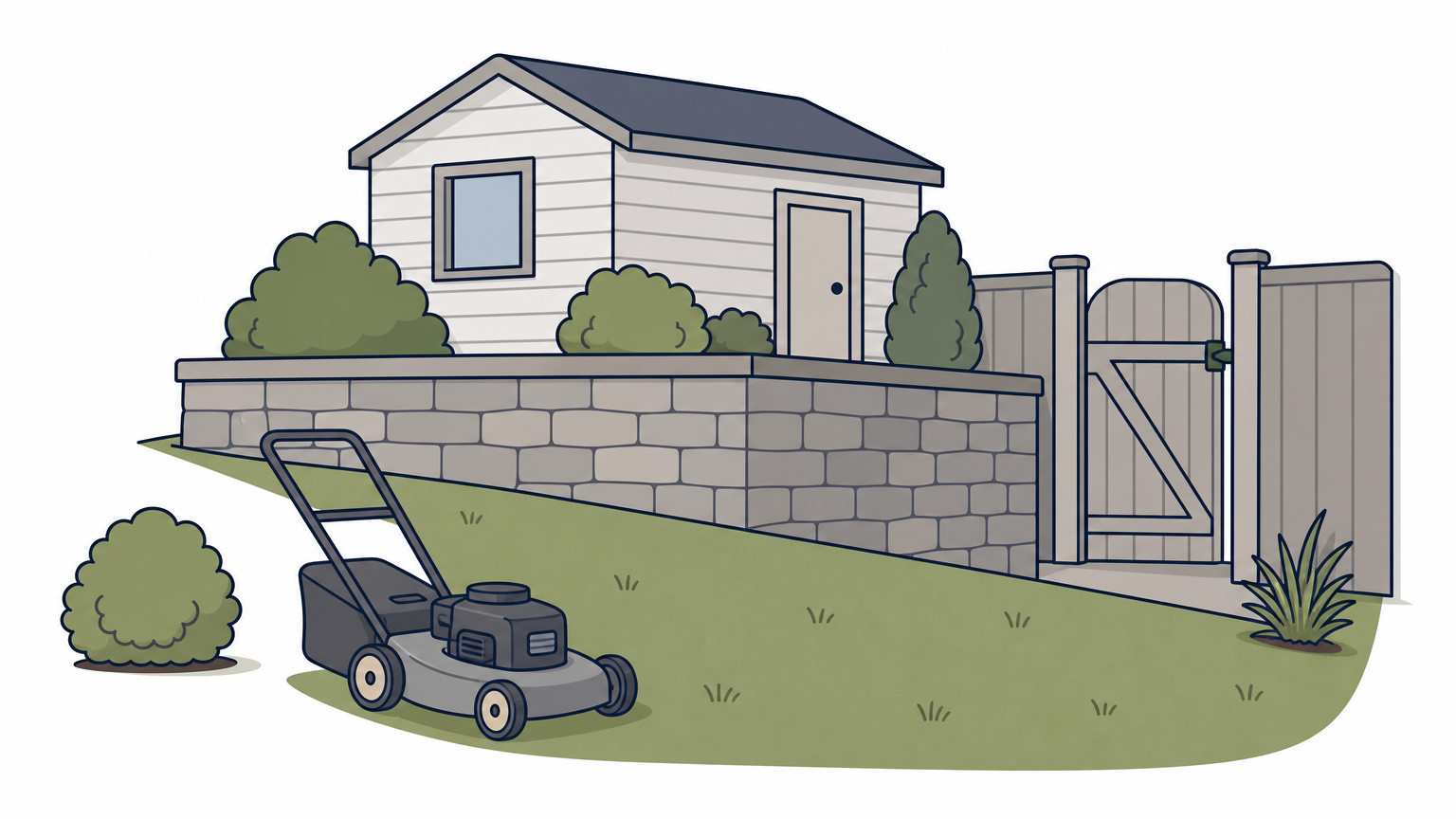
Slopes, drainage ditches, retaining walls, and tight side-yard gates all slow a crew down. Steep terrain sometimes requires push mowers instead of zero-turn riders, which takes longer and wears equipment faster. Fenced yards with narrow gates mean smaller equipment has to be used, or a crew has to hand-carry mowers through. Properties with lots of trees, landscape beds, or decorative borders also need more trimming and edging work per visit. None of this shows up in a simple "per acre" estimate, which is why two properties of identical size can land on very different invoices.
Frequency and contract length
One-time or occasional mowing almost always costs more per visit than a recurring weekly or biweekly contract. Routine crews already know your property, don't need a fresh estimate walk-through every time, and can route your stop efficiently alongside other regular customers in the neighborhood. A one-off mow, especially on a lawn that's gotten overgrown, often requires extra passes, bagging clippings, and disposal time, all of which add to the lawn mowing services price . If you're weighing a single cleanup mow against signing up for the season, expect the per-visit math to look better once you commit to a schedule.
Location and local market rates
Where you live matters too. Labor costs, fuel prices, and local competition all shift the baseline. A property in downtown Columbia might see different pricing than one out in Elgin or Hopkins, partly due to drive time and partly due to differences in typical lot sizes across those areas. Here's a rough look at how these factors stack up:
| Factor | Lower cost tendency | Higher cost tendency |
|---|---|---|
| Lot size | Small, open lots | Large or oddly shaped lots |
| Grass type | Slow-growing (centipede, zoysia) | Fast-growing (Bermuda in summer) |
| Terrain | Flat, easy access | Sloped, gated, obstacle-heavy |
| Contract | Recurring weekly/biweekly | One-time or occasional |
| Location | Rural, wide-open properties | Dense urban lots, longer drive times |
Seasonality plays a role as well. Growth slows dramatically in winter across South Carolina, and many companies either pause mowing or switch customers to a reduced schedule, then shift focus to services like lawn fertilization in Columbia, SC or leaf cleanup. That seasonal shift is worth asking about upfront, since a flat year-round rate isn't always realistic once grass growth drops off in December and January.
Understanding these variables won't give you an exact dollar figure on its own, but it does explain why the range you'll see quoted for lawn mowing services cost is so wide. The next step is narrowing that range down to something specific for your own yard.
How to estimate what you'll pay for lawn mowing
You don't need a professional survey to get a workable number before you call anyone, and the same holds true for pricing out a complete lawn care program. A few minutes with your property and a phone can get you within a reasonable range of the actual price for lawn mowing service you'll be quoted, especially if you follow a simple process instead of guessing.
Measure your lawn first
Start by walking your property and estimating square footage, since most lawn mowing service rates scale with size and time on site rather than a flat per-visit fee. Pace off the length and width of your mowed area, multiply the two, and you'll have a rough square footage figure. If your yard has odd angles, beds, or a pool cut into the middle, break it into smaller rectangles and add them together rather than trying to eyeball the whole shape at once. This single number matters more than almost anything else when a company builds your quote.
Knowing your lawn's square footage before you call is the fastest way to spot a quote that doesn't add up.
Account for complexity, not just size
Next, note anything that slows a crew down: slopes, narrow gates, retaining walls, tight fence lines, or heavy tree cover. A 6,000 square foot lot with a steep bank and a locked side gate takes longer than a flat 8,000 square foot lot with open access, and pricing should reflect that. Write these details down so you can mention them when you request quotes, because leaving them out is the most common reason a homeowner gets surprised by a higher-than-expected invoice after the first visit.
Decide on frequency before you call
Then figure out how often you actually want mowing, since pricing lawn mowing services almost always drops per visit once you commit to a recurring schedule instead of calling for one-off cuts. Weekly service during peak Bermuda growing season versus biweekly service on slower-growing centipede changes your total seasonal spend significantly, even on the identical lawn. Think through your growing season realistically, factoring in the South Carolina climate, rather than assuming every month needs the same treatment.
Request itemized quotes from a few companies
Finally, call two or three local companies and ask for a breakdown, not just a bottom-line number. A useful quote request should cover:
- Square footage or lot size they're basing the price on
- Whether edging, trimming, and blowing off hard surfaces are included
- Frequency options and how price changes with each
- Whether clipping removal or bagging costs extra
- Contract length or cancellation terms
Getting this in writing lets you compare cost of lawn mowing service estimates side by side instead of comparing vague verbal numbers that might not cover the same scope of work.
Once you've got your square footage, your complexity notes, and two or three itemized quotes in hand, you're in a strong position to judge whether a number is fair or padded. At Sparta Lawn Care, we walk every new property before quoting so the estimate reflects exactly what your lawn needs, not a generic per-acre guess. That upfront legwork is what keeps the number on your first invoice matching the number you were told over the phone.
Average lawn mowing rates by lawn size and frequency
Once you know your square footage and your preferred schedule, you can line those two numbers up against typical market rates and get a solid estimate before a single truck shows up. The average cost of lawn mowing service in the Midlands tracks closely with lot size, but frequency shifts the per-visit number too, sometimes by a wider margin than homeowners expect.
Typical price ranges by lot size
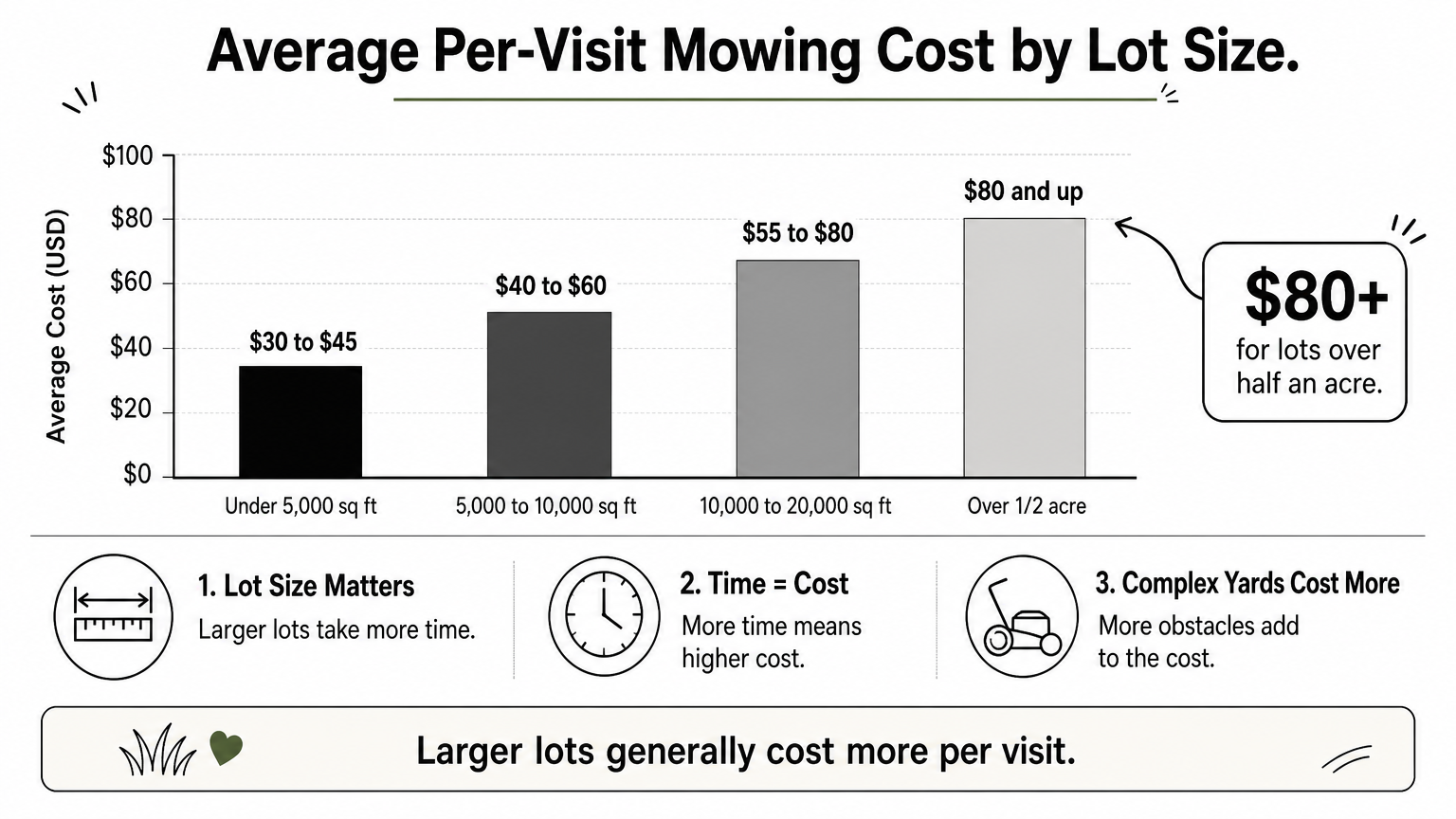
Most residential quotes fall into a few predictable bands once you account for a standard, mostly-open lawn without major complications. Here's how prices for lawn mowing services generally break down for recurring residential customers in the area, and how mowing rates are shaping up for the coming season:
| Lot size | Typical per-visit range | Notes |
|---|---|---|
| Under 5,000 sq ft | $30 to $45 | Small city or townhome lots |
| 5,000 to 10,000 sq ft | $40 to $60 | Common Columbia and Blythewood suburban size |
| 10,000 to 20,000 sq ft (about 1/4 to 1/2 acre) | $55 to $80 | Larger suburban and rural-edge lots |
| Over 1/2 acre | $80 and up | Priced individually based on time and terrain |
These ranges assume a fairly open yard with normal access. Add a pool, heavy landscaping, or a steep slope, and the lawn mowing service cost climbs above the range for that size bracket, sometimes into the next tier entirely, which is worth keeping in mind when you look at what you should expect to pay for mowing.
A half-acre lot with easy access can cost less to mow than a smaller yard packed with beds, slopes, and tight gates.
How frequency changes your per-visit price
Schedule matters almost as much as size. Weekly mowing during Bermuda's peak summer growth keeps grass short enough that each visit stays quick and cheap per cut, while stretching to biweekly on the same lawn often means a longer mow time and sometimes a small surcharge per visit to cover the extra clippings and growth. One-time or occasional mowing sits well above both, frequently 25 to 50 percent higher per visit than a recurring rate, because there's no route efficiency and often extra cleanup involved.
- Weekly service: Lowest per-visit rate, best for fast-growing Bermuda in peak season
- Biweekly service: Slightly higher per visit, common for centipede and zoysia lawns
- Monthly or seasonal mowing: Priced closer to one-time rates, since growth between visits is substantial
- One-time or first-cut mowing: Highest per-visit cost, especially on overgrown or neglected lots
Seasonal timing also shifts the math. A quote you get in June for weekly Bermuda mowing won't match what you'd pay for the same lawn on a reduced winter schedule, so ask any company how their pricing adjusts as growth slows in the fall and winter months.
Commercial and HOA pricing works differently
Commercial and HOA properties rarely price per visit the way residential lawns do. Instead, most crews quote a cost of lawn mowing services based on total acreage, number of common areas, and how many separate mowing zones the property has, then roll that into a monthly or seasonal contract rate. A ten-acre HOA with scattered green spaces and entrance islands costs more to service than a single ten-acre open field, even at the same acreage, because of the extra trimming and drive-time between zones. If you manage a commercial property, ask for a scope-based quote on commercial lawn mowing in Columbia SC rather than a flat per-acre number, since that's what actually reflects the work involved.
What's included in a standard mow and what costs extra
A quoted price only means something if you know exactly what it covers. Two companies can hand you the same dollar figure and deliver very different scopes of work, so before you compare lawn mowing services prices , get clear on what counts as the baseline service versus what shows up as an add-on line item later.
The core services bundled into a standard mow
Most reputable crews build their base rate around a consistent set of tasks in every mowing visit, not just running a mower over the grass. A standard visit typically includes:
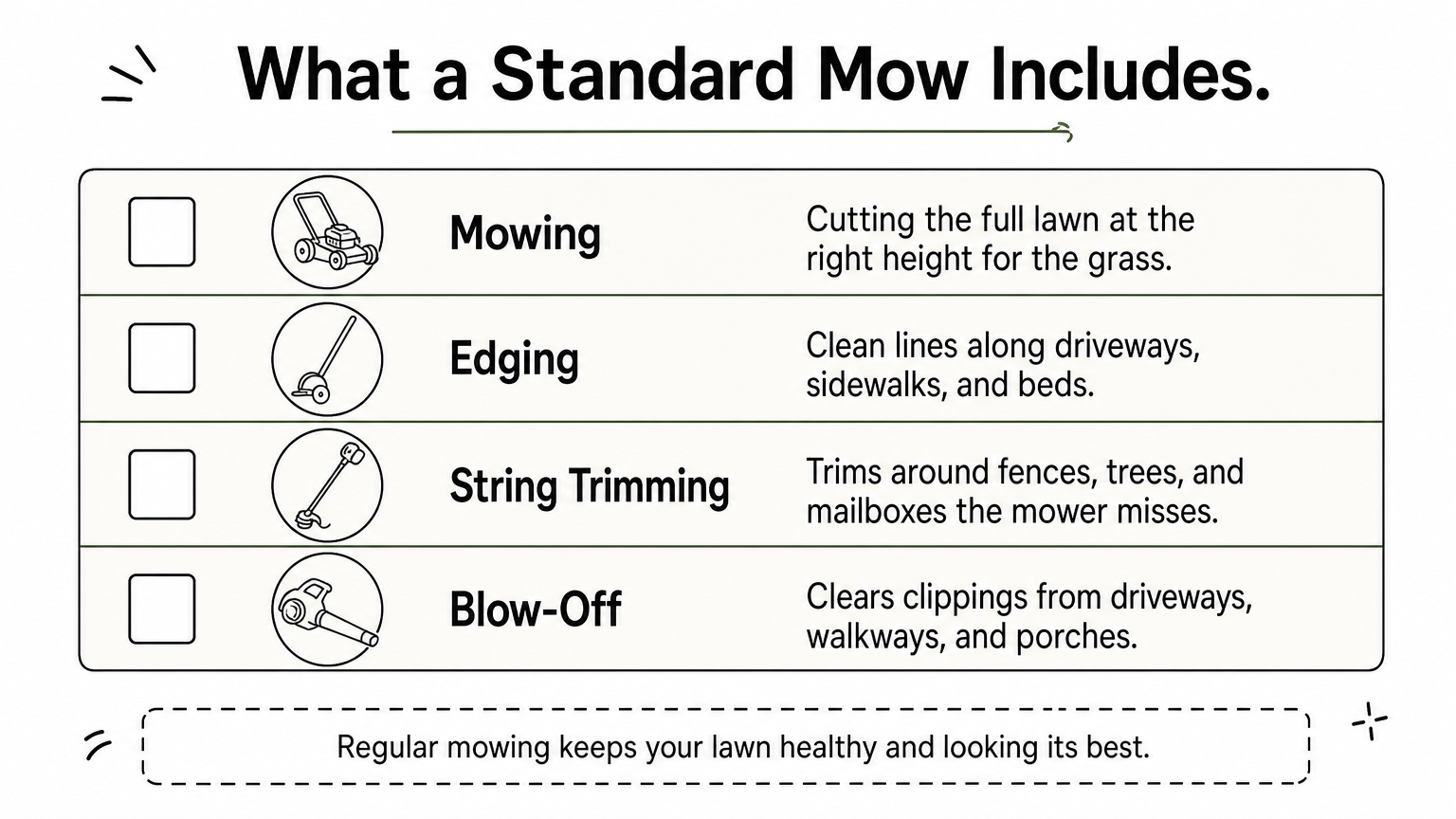
- Mowing the full lawn at an appropriate height for the grass type
- Edging along driveways, sidewalks, and beds for a clean line
- String trimming around fences, trees, mailboxes, and other obstacles the mower can't reach
- Blowing off hard surfaces like driveways, walkways, and porches so clippings don't track into the house
If a quote doesn't mention edging and blow-off, ask directly, because leaving them out is the easiest way to undercut a competitor's price on paper.
When you're comparing a price of lawn mowing services between two companies, make sure you're comparing the same bundle. A rock-bottom number that skips edging and blow-off isn't actually cheaper once you factor in the extra thirty minutes you'll spend cleaning up grass clippings yourself.
Common add-ons that cost extra
Beyond the core mow, several services get billed separately because they don't apply to every property or every visit. Grass clipping bagging and removal is one of the most common, since most crews mulch clippings back into the lawn by default and only bag on request or when clippings are excessive after a missed cutting. Overgrown lawn cleanup is another, especially for a first mow on a lot that's gone unmowed for a month or more, which often needs multiple passes and takes real extra time. Flower bed weeding, hedge trimming, and mulch installation typically fall under a separate landscaping quote rather than the mowing rate, even though they get requested together often enough. Fall yard cleanup and storm debris removal after heavy wind or rain events also sit outside a standard mow, since neither happens on a predictable weekly basis.
Ask these questions before you sign anything
Getting a full picture of your cost of lawn mowing service means asking pointed questions rather than assuming the quote covers everything you picture in your head. Before agreeing to a schedule, confirm:
- Is edging done every visit or only periodically?
- Are clippings mulched, bagged, or hauled away, and does that change the price?
- What happens if the lawn gets overgrown between scheduled visits, say after a rained-out week?
- Is there a separate charge for the first mow if the lawn is taller than normal?
- Are seasonal add-ons like leaf cleanup billed separately or bundled into a package?
Walking through these questions upfront saves you from a surprise invoice after the first cut. It also gives you a real basis for comparison, since a lower headline number that excludes half these tasks isn't actually a better deal. At Sparta Lawn Care, we spell out exactly what's included in every lawn care visit before you commit, so there's no guessing about what you're paying for from one week to the next.
How to tell if a quote is fair
Getting three numbers back from three companies doesn't tell you much if you can't judge which one actually reflects your yard. A fair quote for lawn mowing service lines up with the size and complexity of your property, spells out exactly what's included, and doesn't leave you guessing about hidden fees down the road. Knowing what to look for separates a legitimate price from either a lowball bait-and-switch or padded number meant to take advantage of someone who hasn't shopped around.
Red flags in a suspiciously low quote
Watch for a number that sits well below every other estimate you've gathered, especially if the company can't explain why. A quote 30 or 40 percent under everyone else's usually means something's missing from the scope, whether that's edging, blow-off, or a realistic time estimate for your lot. Some companies use a rock-bottom first-visit price to get a foot in the door, then raise the rate once you're locked into a schedule, so ask directly whether the quoted number is permanent or introductory. Vague answers about what's included, or reluctance to put the scope in writing, are both signs the low price won't hold once work actually starts.
A quote that's dramatically cheaper than every competitor almost always means something got left out of the scope.
Signs of a legitimate, fair price
A trustworthy quote usually comes with specifics rather than a flat number pulled out of thin air. Legitimate companies typically:
- Walk the property or ask detailed questions about size, terrain, and obstacles before quoting
- Explain their rate in terms of time, square footage, or scope, not just a round dollar figure
- Put the included tasks (mowing, edging, trimming, blow-off) in writing
- Offer a clear cancellation or satisfaction policy instead of locking you into a rigid contract with no recourse
- Carry insurance and can confirm it if you ask
Noticing even two or three of these signs of a mowing company worth hiring is a good indicator you're dealing with a company that prices honestly rather than one hoping you won't check the details.
Comparing quotes apples to apples
Once you've gathered a few estimates, line them up side by side using the same categories rather than comparing bottom-line numbers alone. A price for lawn mowing service that looks higher on paper might actually be the better deal if it includes bagging, weekly edging, and a satisfaction guarantee that the cheaper option skips entirely. Ask each company the same set of questions when you're shopping local mowing companies, so the comparison is fair, and don't be afraid to go back and ask a company to clarify anything vague in their written estimate. This step matters more than most homeowners realize, since the real cost of a service isn't just the number on the invoice, it's the number on the invoice plus whatever you end up doing yourself because a task got left out.
Sparta Lawn Care backs every quote with a guarantee on the work itself, meaning if something about a visit isn't right, we fix it at no extra charge until you're satisfied. That kind of backing is worth factoring into your comparison, since a guarantee like that protects you from the exact surprises a vague low quote tends to produce.
Getting the best value from a lawn care service
Paying a fair rate is only half the equation. Getting real value means the money you spend actually buys you a lawn that looks good all season, not just a mowed patch of grass with a surprise bill waiting behind it. A few practical habits separate homeowners who get their money's worth from those who keep switching companies every year looking for a better deal.
Bundle services with one provider
Homeowners who use a single company for mowing, fertilizer and weed treatments for their turf, and seasonal cleanup often pay less overall than those juggling separate vendors for each task. One crew that already knows your property doesn't need a new walkthrough or estimate every time you add a service, and many companies offer a modest discount for bundling recurring work under one contract. It also cuts down on scheduling headaches, since you're coordinating with one team instead of three different companies who may not talk to each other about who mowed over whose fresh mulch.
Bundling mowing with fertilization and cleanup under one crew usually costs less than hiring three separate vendors for the same yard.
Commit to a recurring schedule
Earlier sections already covered how one-time mowing runs 25 to 50 percent higher per visit than recurring service, and that gap is exactly where the value lives. Signing up for a season of scheduled mowing and edging visits instead of calling as-needed locks in a lower per-visit rate, gives you a consistent crew that learns your property's quirks, and removes the guesswork of scheduling around growth spurts. Consistency also protects your lawn's health, since a lawn mowed on a predictable schedule handles South Carolina's heat and rain better than one that gets cut in bursts after it's already overgrown.
Communicate clearly with your crew
Value drops fast when a crew doesn't know what you actually want. Take five minutes before your first visit to walk the property with whoever's mowing, point out anything fragile like sprinkler heads or young trees, and confirm mowing height preferences for your specific grass type. Ongoing communication matters too. A quick note about a broken fence gate or a new flower bed keeps your crew working around your property correctly instead of guessing, and most companies would rather hear about a concern early than fix a mistake after the fact.
Look past the lowest number
The cheapest lawn mowing services price on paper rarely stays the cheapest option once you factor in missed spots, inconsistent scheduling, or a crew that skips edging half the time. Real value comes from a company that shows up reliably, does the same quality work every visit, and stands behind that work if something goes wrong, which is why it pays to know what to weigh before hiring a lawn care company. That's the thinking behind the Sparta Family Guarantee at Sparta Lawn Care, where any issue with a visit gets fixed at no extra cost until you're satisfied. A guarantee like that means the number you're paying actually buys peace of mind, not just a mowed lawn and a hope that nothing goes wrong between visits.
Choosing a rate you can count on
At this point, you know what drives lawn mowing service rates , how to measure your own yard, and what separates a fair quote from a padded one. The number on your invoice should reflect your lot's actual size, terrain, and schedule, not a guess pulled from a generic price list. Homeowners who ask the right questions upfront, request itemized quotes, and confirm what's bundled into a standard mow rarely get blindsided later.
Rates will always vary some from yard to yard, and that's fine as long as you understand why. What matters more than chasing the lowest bid is finding a crew that prices honestly and shows up the same way every visit. If you're ready to get a real number for your property instead of another vague estimate, request a free mowing quote for your yard from Sparta Lawn Care, built around your actual lawn and backed by the Sparta Family Guarantee.