

5 Types of Commercial Lawn Mowing Services to Compare
The best commercial lawn mowing services give you a written scope, proof of insurance, a consistent crew, and a price per visit or per month that you can check against the work. An HOA or multi-building property usually fits a full-service local company. A single small lot can work with a solo operator. An owner with sites in several states may need a national contractor.
Most bids look alike on price. They differ in what they cover: edging, blowing hard surfaces, trash pickup, backup crews when a mower breaks, and who actually shows up each week. Switching vendors mid-season is expensive and leaves the property looking neglected, so the first choice matters.
This article walks through five provider types, starting with our own company, Sparta Lawn Care, which serves the Columbia area and the wider Midlands. For each type, you get how the service works, who it suits, and how it is priced. Warm-season grasses such as Bermuda, Zoysia, and Centipede grow hard from spring into fall in South Carolina, so mowing frequency and crew consistency matter more here than in cooler climates.
1. Sparta Lawn Care: local crew-based service
Sparta Lawn Care is a veteran-owned, locally owned company that handles commercial lawn mowing for businesses and HOA common areas in Columbia, Blythewood, Elgin, and the surrounding Midlands.
How it works
Mowing sits inside the Commercial Lawn Care & Maintenance program, and the same crew returns to your property each visit. A familiar crew learns your gates, irrigation heads, slopes, and wet spots, which cuts down on scalped patches and missed areas. The team knows Bermuda, Zoysia, and Centipede , and each grass needs its own cutting height and schedule. The company is licensed and insured and has more than 20 years of experience.
You can bundle the work around mowing with the same vendor:
- Fertilization and weed control with slow-release granular formulas
- Core and liquid aeration followed by commercial overseeding
- Spring cleanups and fall cleanups with leaf removal
- Commercial landscaping services
A mowing contract is only as good as the crew that shows up, so ask who will be on your property every week.
Who it suits and what it costs
This option suits property managers and HOA boards who want one accountable vendor for mowing, turf treatments, and seasonal cleanups instead of three. The Sparta Family Guarantee promises to fix any service issue at no extra cost until you are satisfied.
Ask for a written quote. Billing runs through an online client hub powered by Jobber, with credit card payments only, so tell your accounts payable team up front. Call or text (803) 261-1485, Monday to Friday, 8:30am to 5:00pm.
2. Solo operators and small crews
A solo operator or a two-to-three person crew is usually the cheapest way to buy commercial lawn mowing, and it works best on small, simple sites.
How it works
One owner runs the truck, trailer, and mowers. You get a per-cut or hourly price and often a one-page agreement. The weak spot is backup coverage . If equipment breaks or the owner is out sick during a rainy week, your property waits. Check proof of insurance before the first cut, because a solo operator without liability coverage leaves you exposed if a stone hits a car window.
Ask these before you sign:
- Can I see a certificate of insurance that names my business?
- What happens when your mower breaks or a storm delays the route?
- How many properties do you cut on a typical day?
The cheapest bid is often the one with no plan for the week something goes wrong.
Who it suits and what it costs
Small offices, single-tenant buildings, and daycares with a modest lawn fit this type well. Expect one of four pricing models, and know which one your bid uses.
| Pricing model | How it works | Best for |
|---|---|---|
| Per visit | Flat fee for each cut | Small sites with a steady scope |
| Hourly | Rate multiplied by time on site | Irregular jobs and cleanups |
| Monthly flat | Season cost split into equal payments | Budgeting for offices and HOAs |
| Annual contract | Fixed visits plus listed extras | Properties with several services |
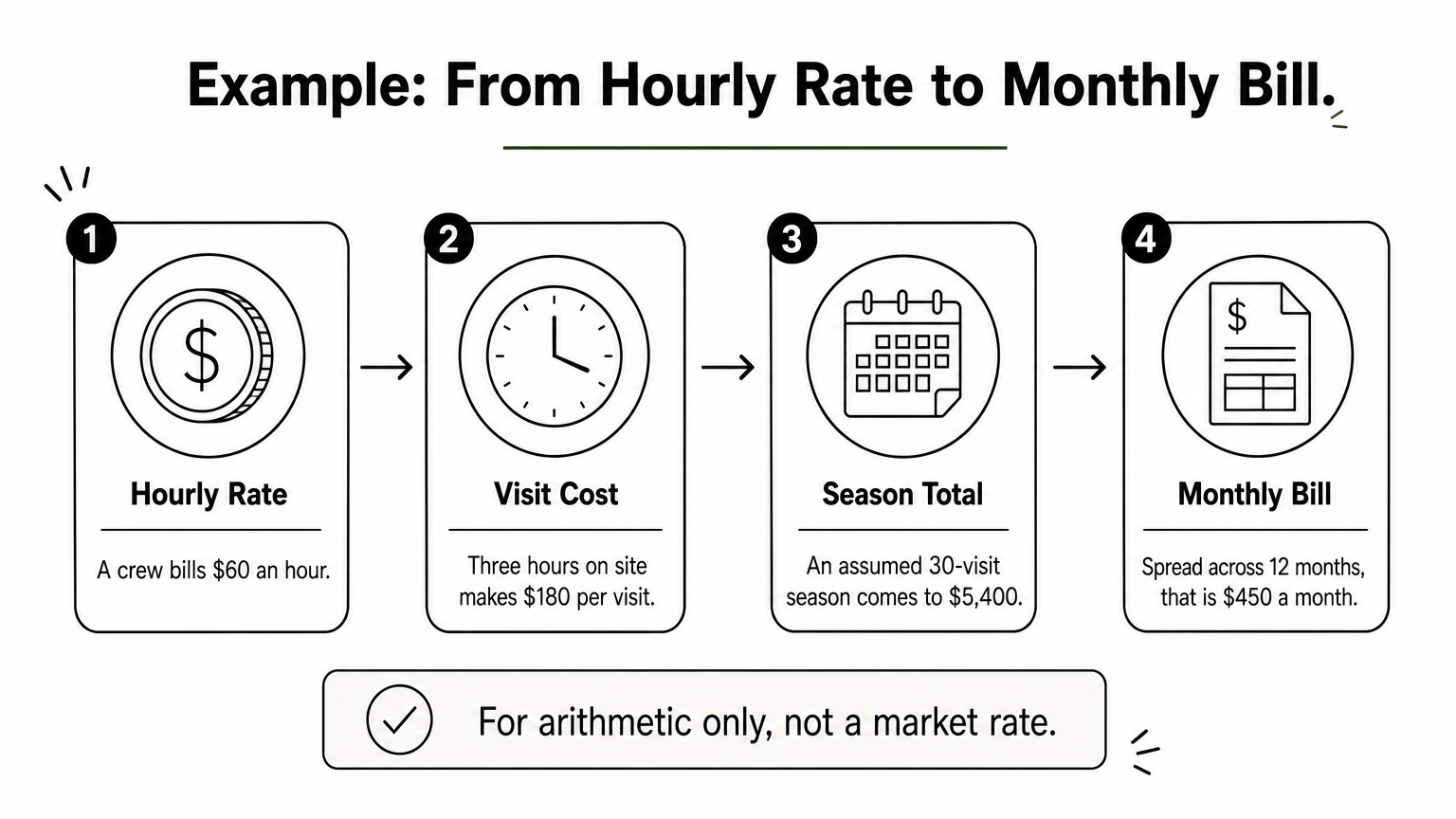
Here is a worked example, for arithmetic only and not a market rate. A crew bills $60 an hour and needs 3 hours, so each visit costs $180. Over an assumed 30-visit season, that is $5,400. Spread across 12 months, it becomes $450 a month. Ask whether a flat monthly bill continues through dormant winter months.
3. Franchise grounds-maintenance companies
Franchise grounds companies give you a standardized process and a corporate brand behind the local crew, which suits businesses that want uniform service across locations.
How it works
A local owner licenses a national brand and uses its service packages, scheduling software, and written agreements. Crews are often uniformed, and the proposal usually follows a site walk. Mowing is one line in a larger grounds package, so you may pay for services you did not ask about.
Read the contract for these points:
- Term length and automatic renewal
- Annual price escalators
- Whether crews are employees or subcontractors
With a franchise, you are buying a process, so read the contract the way you would read a lease.
Who it suits and what it costs
Retail centers, medical offices, and corporate campuses that want consistent branding and reporting fit this type. Franchise pricing is often higher than a solo operator's because of brand and overhead costs . Expect a priced proposal after a site visit. Compare it line by line against other bids, since scopes rarely match. If one bid includes edging, debris blowing, and trash pickup and another does not, the lower number is not really lower.
4. National commercial landscape contractors
Large national contractors make sense when you manage many properties and want a single contract, one invoice, and one account manager.

How it works
You usually go through a bid or request-for-proposal process . The contractor assigns an account manager and may use local subcontractors for the actual mowing. For a single site, this is often more process than you need. For a portfolio, it saves real administrative time.
A good bid package lets every vendor price the same job. Include:
- Turf square footage and a site map
- Season dates and visit frequency
- Mowing height, edging, and blowing standards
- Debris and trash handling
- Insurance requirements and response times for complaints
Bidders can only price what you describe, so a detailed scope is the cheapest quality control you have.
Who it suits and what it costs
Owners of multi-site portfolios, regional property managers, and institutions with procurement rules suit this type. Pricing arrives as itemized written bids , and larger accounts often negotiate. Ask how invoicing works and whether payment runs through a portal. Also confirm that the crew mowing your site is covered by the contractor's insurance, not a subcontractor's.
5. Marketplaces and directory listings
Directories and quote platforms do not mow your lawn. They list providers, which makes them a useful way to build a shortlist and a poor way to make the final hire.
How it works
You browse listings, read ratings, or submit your address and receive responses. Some platforms generate instant estimates from property measurements. Treat those as ballpark figures only , because they rarely reflect commercial scope such as parking-lot edges, retention ponds, or HOA entrance beds. Many listings also lean residential.
Vet every shortlisted provider with this checklist:
- Confirm they actually take commercial accounts
- Request a certificate of insurance
- Ask for two references from commercial properties
- Get a written quote with the same scope as every other bid
A star rating tells you how a stranger felt about a residential lawn, not how a vendor handles your property.
Who it suits and what it costs
This route suits owners who are starting from zero and want three comparable bids fast. Browsing is typically free, and the provider sets the price. Use the listings to find names, then call each company and walk the site together. A provider who will not walk the property before quoting is guessing.
Choosing the right mowing partner
Match the provider type to the property. Small, simple sites can work with a solo operator, large portfolios belong with national contractors, and most local HOAs and business properties are best served by a full-service local company with a steady crew. Whoever you pick, compare written quotes with the same scope and verify insurance first.
If you manage a business or HOA property in the Midlands, talk to Sparta Lawn Care about your property and get a written quote you can compare against any other bid.